travel

Nam Kading Research Centre

The World Conservation Society has operated a research centre on the banks of the Nam Kading river for several years, and recently they’ve opened it up to travellers who want to stay there. The guidebook mentions it and it piqued my interest, so when I saw a current brochure about the place in Vientiane I made contact by email. It sounded intriguing: accessible only by boat or a rough road and in a picturesque location on the edge of the Nam Kading national park, it promised basic but comfortable digs from which you can explore the area. I wasn’t sure I really wanted to go until the morning I left Paksan – indeed I didn’t really make the decision until I was standing at the bus station…

It was worth the effort. My first trip on a sawng-thaew, a flatbed truck converted to carry passengers with two benches running lengthways down the tray and a canopy above. It’s the most common form of transport in rural areas, best-suited and most frequently available for journeys of up to 50-100kms, and I’d seen them all over northern Laos but never had the need to catch one before now. After jumping off at Ban Nongkham, a tiny speck of a settlement barely worth a name, it was a short trip on the back of a motorcycle (I was too lazy to walk it) to the banks of the river, where for 80,000 kip ($11) a longtail boat took me upriver for half an hour to the research centre. The centre has the feeling of a school adventure camp, situated high on the riverbank with several raised wooden buildings in a gentle forest glade. The pristine Nam Kading river can be seen through the trees, and the “Boys Own” feel was accentuated by the three young male staff on site. I was the only guest staying there that night, it turned out.

After settling in to my room – I had the pick of eight identical cells each with two single beds, mosquito nets, pillows, blankets, and nothing else – I asked for some lunch as I hadn’t had breakfast. There was no menu offered, I simply heard some chopping and frying taking place in the open kitchen underneath one of the huts (it turned out to be a tasty mix of sauteed shiitake mushrooms, fried eggs and sticky rice). While it was being prepared the head guy there, a boy-man called Khong who was probably twenty-something but looked younger, began his soft-sell about the various treks they have to offer. None of them really appealed, especially as the supposed highlights were a couple of waterfalls that looked like small rapids (at best) from the pictures. Even with my new-found adventure focus I don’t want to traipse through remote jungle unless there’s something worthy to look at! It made me wonder just how much research is actually done at this place, though to be fair it was the day after Christmas and most of the normal crew were probably back home with their families. I chose instead for the low-key option of being boated upriver a short way to the nearest “waterfall”, and then tubing back. I use inverted commas for the “waterfall” because while it’s big enough to prevent a boat going upriver, it doesn’t fall that far. Two metres, actually, hardly a big attraction in my book but it was located in a picturesque part of the valley. Getting there involved scrambling over rocks for quite a while, and the tubing started with a leap off the edge of the falls into the cool water below. We didn’t float very far downriver, but it was fun while it lasted and much more relaxing that doing the same thing in the tubing heaven/hell of Vang Vieng.

That was the highlight of the day, in terms of action. Because I didn’t want to trek the boys left me to my own devices, and I happily sat at an outdoor bench overlooking the river and started a new book. The peace was almost complete, broken only by different birdsongs and a very occasional engine rumbling past the road behind the camp. Dinner was served early at 6pm, and all four of us tucked into a simple but delicious meal of sauteed cauliflower with shreds of beef, fried egg, sticky rice and mushroom soup with lemongrass. I crashed out very early, and later I heard some motos arrive as the boys had some guests from the nearby village over. Guitars were brought out and I was tempted to join, but an unexplained fatigue took me off to sleep before I could act. Waking the next morning I was still tired, and somewhat cold as a powerful wind had developed overnight and was still blowing hard. Breakfast was yet more sticky rice with fried egg and diced beef, then afterwards another boat and moto trip back to the main road to head further south. The Nam Kading Research Centre was an interesting and definitely off-the-beaten-track place to stop, though I’d recommend it only if you have oodles of time to spare or are very keen on getting into the wilderness of central Laos.

Categories: Laos, travel | Leave a comment

Paksan

Getting to Paksan was by far the best bus journey I’ve had so far. After a couple of weeks of being in big cities and hanging around lots of other travellers, I felt a strong urge to get away from them all as far as possible. Which made my choice of transport a no-brainer when I wanted to head to south: local buses all the way.

There are numerous “VIP” buses and minivans that offer to deliver you in relative comfort from Vientiane to the tourist hotspots of Tha Kaek, Savannakhet and Pakse, and they’re all good value. But they are almost entirely patronised by westerners, many of whom don’t have the time to visit the spaces in between. I was looking for a different experience this time, and the VIP buses also leave very early in the morning which did not appeal at all. So I rose when I felt like it, did some Christmas Day contacting and then got a tuk-tuk to the southern bus station. There was a local bus leaving to Paksan in half an hour – perfect. And it was dirt cheap: the 9km tuk-tuk to the bus station cost 50,000 kip (A$7), whereas the 100km+ journey to Paksan cost only half that 🙂

The bus left exactly on time, which was a bit of a shock. But we only made it two hundred metres before it slowed down to let more than a dozen hawkers on board. They agressively went up and down the aisle trying to flog drinks, chewing gum, books, barbequed chicken, sticky rice and more, and it was another twenty minutes before we set of in earnest. Stopping frequently to pick up more passengers on the way, the conductor got increasingly creative with the seating arrangements as the bus filled. When every seat was taken, he produced from nowhere a large plastic stool so the next guy could sit in the aisle in comfort. When more got on, they were directed to the lumpy sacks filling the back half of the aisle. Later arrivals simply leaned against the nearest post. I was the only westerner on board, and I was joined on my seat by a young man who was returning to his home village just south of Paksan. He’d been competing in the South East Asian Games which have just finished in Vientiane, and he’d won his division of boxing. He was very proud of the fact and discreetly showed me the gold medal hidden in his beltbag.

Once out of town the ride was a dream, and completely different from travelling in the north. The road is flat, straight, paved and almost bump-free, which mean we could overtake safely and travel at the rare speed of 50 kmh or more! Several times we slowed to pick up or set down, or to invite more food sellers on who hawked their wares as the bus slowly rattled a few kilometres down the road. They got off well away from their start point, presumably to wait for the next bus heading the opposite direction so they could try again. The bus was ancient, of course, but it was still kitted out with a television and dvd player in the console above the driver’s head. That’s one thing I’ve noticed here: no matter how old the bus, how crappy the seats or how rough the suspension, Laotians certainly know how to wire together a sound system. Even on the juddering ride to Phongsali there was an old amplifier strapped beside the driver, and quality speakers lashed to posts throughout the bus. They sounded fantastic, burrowing the Lao and Thai pop that was blaring away endlessly deep into your head. It’s not as awful as it might seem.

Arriving in Paksan earlier than I expected, I wandered from the bus stop to where a decent guesthouse and restaurant were supposed to be and took stock of the place. My guidebook is dismissive (“we’d like to say there is nothing much to see in Paksan, but that would be overstating it”), but for my needs at the moment the fact it’s right is not the point. For a change I was looking for somewhere that tourists barely notice, let alone stop in, and this fits the bill perfectly. It’s actually the first place that’s made me think of an Australian country town. Situated on a flat plain and broadly distributed around a river crossing, the main road – the highway – has shops and other services spread distantly along its length, and the side roads are wide and quiet. There are suburban houses (or the local equivalent of, anyway), even picket fences in places, and further from the main road are pastures, crops and sparse bush. And it’s hot. If I start seeing cattlemen in Akubras walking down the street, I’ll lay off the Beerlao for a while.

later…

Walking down the road a few kilometres to the river. Kids hurtle past, rushing away from school on scooters. By the rushed shore of the wide, languid Mekong two women tend fishing nets in the afternoon sun. Thailand nestles prosperous on the far shore. Past a large field where youngsters play volleyball watched by their parents, Christmas carols blasting loudly from the sound system. In English. I remember from the guidebook that this part of Laos has a high proportion of Christians, improbably. It feels like any other country suburbia. I see no westerners apart from an older woman with cropped blonde hair riding past. We wave at each other heartily – perhaps she’s the French woman who’s also staying at my guesthouse tonight? We carry on our ways. Later at the nearby restaurant, reading, sipping a cool beer in the dark evening. Later still some outstandingly fresh fish, battered and deep fried. Cut vertically to make the bones easy to avoid, it’s delicious. Now I know why a constant stream of people drop by to pick up takeaway, the oil’s sizzle heralding the despatch of yet another meal. A brief chat with an older man who installs solar panels up and down the country. He wonders why am I not celebrating Christmas today? Back at the guesthouse I sit on the balcony writing this post. Pop music wafts loudly from a neighbouring house, muted by the shrill of crickets. From the gloom a figure approaches: It is the french woman, the same one I saw this afternoon. We sit for several hours chatting about our travels and I get and give lots of useful advice. When we part at 11.30pm the music from the nearby house has been replaced by an indistinct low male voice. It is a wedding, I’m told. Back in my room I finish my book: William Boyd’s well-written but somewhat unsatisfying Brazzaville Beach. Tired, sleep comes quickly, a calm, fulfilling rest. Tomorrow will be even more remote.

Categories: Laos, travel | Leave a comment

Christmas in Vientiane

Last year I spent Christmas in Qingdao in northern China, where the highlight of the day was a decadent two and a half hour foot and body massage followed by a walk around town in near-freezing conditions. This year I’ll be spending it on a bus heading to southern Laos, and the temperature will top 30 degrees before 11am. The memory of Christmas past is still a little too raw to be in Australia or New Zealand right now.

My second stay in Vientiane has been another relax-fest, though for the first full day I was ill so I simply spent it lounging around my hotel room with its view over the Mekong River. Since then it’s been good food, some random meetings with other travellers, a luxurious two hour massage, walking, tv time and reading. Yesterday I faced a choice: get a bus outta town or stay one more day. I was conflicted because I felt like I was idling needlessly, but then I remembered that is in fact the point of this journey! To have the freedom to sit still if that’s what I wanted. Decision made, it was a fine day 🙂

Bloody hot too, a perfect pool day, so I hired a bike and rode out to the Australian Embassy Recreation Club. It apparently has the best pool in the city and until a couple of years ago it was open to all upon payment of a day fee. But I discovered on arrival that it’s now exclusively for members – not even expats from other countries can join. I later found a blog post from two years ago that said it used to be a popular meeting place for expats, especially wives of embassy-types with young children. But in its wisdom the Australian Government has closed it off to outsiders, so I was forced to find another option. Fortunately the Settha Palace Hotel has a fine pool which you can use for a fee without staying there, and though noone was around it was a nice place to kill a couple of hours and work on the tan.

Today I’m ready to move, though I still don’t exactly where I’m going. The short-term goal is Kong Lo Cave, a river that runs for seven kilometres underneath a mountain. It’s apparently spectacular and one of the best natural wonders of Laos. But there are several other places on the way that sound interesting, so I don’t know exactly when I’ll get there… I’m simply going to go to the southern bus station shortly and see what’s leaving when I get there. I may be off-the-grid for a few days, but will definitely be online again within a week when I get to Tha Kaek.

Merry Christmas and Happy New Year to all!

Categories: Laos, travel | 1 Comment

Hanoi downtime

I’d intended to stay in Cat Ba town for a couple more days, then head back to Hanoi for one more night before my flight to Vientiane. Cat Ba is supposedly a backpacker-oriented place with lots of adventure activities on offer such as kayaking, rock-climbing and trekking through the national park. But other travellers I’d met had said that it was a dirty, unattractive town and I shouldn’t bother to stay there. I seriously considered hanging out on the private island instead as it’s a very peaceful place, with its comfortably rustic beachfront bungalows, kayaks available and several walking trails behind the resort. But the price was an eye-popping US$70 a night – too much to contemplate in an area where fine hotel rooms with all mod cons and harbour views can be had for just $15-20. And the weather was still cold and grey, so even the kayaking wouldn’t have been much fun. The reports were right about Cat Ba town, too. As part of the tour we had half an hour to wander around it before some mountain biking, and it was decidedly uninviting. Judging by the number of hotels it must be pumping during high summer, but this time of year is definitely the off-season and there were few tourists about. The locals were taking advantage by building or renovating hotels and the roads and sidewalks were being upgraded; it was a like living in a giant construction site.

With a few extra days in Hanoi I’ve been quite content to just relax and enjoy the benefits of this large city while I can. Good western food (including some sensational gnocchi al pesto at an Italian restaurant, and roast New Zealand lamb with garlic potatoes at La), book and DVD shops to browse, a modern cinema where I saw Avatar in 3D today, cruisy bars and cafes for socialising, street food and wandering the lanes and alleys when I want another taste of Vietnam, and reliable internet connections to keep in touch with the world. All these things will be rare or non-existent once I leave Vientiane and won’t be common again until Phnom Penh or Bangkok, so I’ve made the most of the opportunities.

I’ve also had some time to reflect on my first month in Asia. One of the main reasons why I wanted to come here, and to Laos in particular, is that I want to experience first-hand what it’s like to live in a developing country. Not live as most locals do, of course: as a westerner I have far more money than they could ever dream of having, and staying even in basic guesthouses and eating modestly I would still be indulging a lifestyle far removed from their day-to-day existence. But we have to share the same infrastructure – roads, buses, electricity, water, shops, etc – and from this I can gain some understanding. I didn’t expect it to be easy all the time, and it’s not. But 80% of the world’s people live in circumstances that are at best challenging, and at worst appalling. I wanted to see this for myself and not just watch it on television or read about it in a book.

Even the term “developing country” has taken on new meaning. It’s certainly better than using outdated phrases such as “third world” (ie. really poor) and “second world” (not really poor, but not western either), or slightly improved versions such as LDC (“less developed country)”, though I admit to using those myself as easy shorthand classifiers at times. But “developing country” is more appropriate because these countries really are changing, and sometimes quite fast. A few days ago at a bookshop I was talking to the owner, an older Australian man with extensive knowledge of Asia who has lived here for nine years. He was describing the changes seen in Hanoi since he arrived, and said that when he came there were virtually no cars, about half the population got around on bicycles and the other half on scooters. Three to four years ago the bicycles had largely disappeared as most people could now afford scooters, then gradually cars started creeping in as well. Now cars are quite common here, and in his opinion they are one of the biggest causes of Hanoi’s infamous traffic congestion. “What’s really needed is an elevated mass transit system like they have in Bangkok”, he said, “so that people can get around without using scooters”. He says that such a system will come, and in fact the latest Lonely Planet notes that work on a metro system is due to begin soon. “Change is inevitable, and it changes the character of the city. The pinnacle they’re aiming for is to be like Singapore, but when you get to that level a city loses its soul. But you can’t stop progress, and nor should you as it makes peoples’ lives better. We just have to accept that things won’t always be the same here.”

I’ve experienced many different stages of development already, from tiny villages north of Phongsali where there is no electricity nor any shops, to modest Lao towns with an unpaved main street and just a handful of guesthouses and restaurants, to the electrifying buzz of Hanoi. It’s nice here but I’ve had enough of the bustle of Vietnam to be honest, and I’m really looking forward to getting back to the laid-back charm and gentle people of Laos. And I’ve worked out that I really do enjoy doing certain adventure-type activities, so I’ll be going out of my way to do more kayaking, mountain-biking and trekking when I get there 🙂

Categories: travel, Vietnam | Leave a comment

Halong Bay and Lan Ha Bay

Halong Bay is one of the iconic images of Vietnam, comprising almost two thousand jagged limestone islands topped with dense vegetation all rising sharply from the water. This spectacular setting has been a tourist attraction for hundreds of years, and today there are numerous options to visit Halong Bay ranging from a day trip on a public boat to multiday adventures including overnight stays on a boat or onshore hamlets. It’s at risk of becoming overrun, I fear, but at this time of year at least the hordes are few. It’s got to the point that some tours focus instead on neighbouring Lan Ha or Bai Tu Long bays, using their relative unpopularity as a selling point. I am not normally a fan of organised tours, preferring instead to find my own way around, but I recognise that for specific purposes they can be good. I followed the guidebook’s advice and checked out a specialist tour operator that offered slightly different tours and has a reputation for quality, and was pleased to find a 3-day/2-night package that took in both Halong and Lan Ha bays, with some desirable adventure activities too. Best of all it offered two nights accomodation in waterfront bungalows on a private island on the edge of Lan Ha Bay and the price was affordable, so I signed up. It was a good decision: every part of the tour from the activities to the connections to the bungalows were well-chosen and seamlessly integrated. It really made for a great couple of days, despite the cold and grey weather!

After a long minibus ride from Hanoi to Halong City we were quickly shuttled through the crowds to our boat for the cruise through Halong Bay and lunch. Like most of the boats on the bay this was a large wooden affair, but of high standard and large enough for forty people to have a sit-down meal. However there were only fourteen of us so there was plenty of space, and the set meal was surprisingly good including fresh prawns, spring rolls, stir-fried pork and veges, grilled fish and rice. We headed into the bay and got to know each other a little as the islands floated past, and after an hour we pulled into a secluded section for the kayaking. The kayaks are tended by another boat and drawn up to us, so there were no other groups around as we spent an hour paddling through a low cave-like tunnel to a hidden lake surrounded by high karst cliffs. The acoustics were sensational, you could hear the flap of a hand in the water from the other side of the lake and it was eerily quiet with not even a bird to be heard. After an hour we headed back to the boat, and I noted a couple of other vessels waiting their turn to use the kayaks. Continuing through Halong Bay and around the edge of Lan Ha bay to our island digs, we arrived just after dark to unpack and have a very welcome warming shower before dinner.

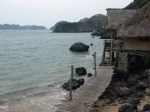
The bungalows were fantastic: best described as comfortably rustic, they are constructed entirely of bamboo and located quite literally on the edge of the water, with little more than a double bed and a bathroom inside and a balcony out front. But the beds are soft with electric blankets included (a godsend!), the bathrooms are modern and clean and the water gloriously hot. There’s a mosquito net over the bed to but no mozzies at this time of year, however our guide said we should use them anyway just in case rats come down from the mountain behind the resort. We were dubious and asked if he was joking, he chuckled heartily and then said “no” with a firm voice. Everyone used their mosquito nets that night. It turned out to be a very late one for some of us, and I went to sleep to the gentle sound of waves lapping on the beach below.

Of the fourteen people who arrived only nine of us were staying two nights, and we were all extremely glad of it. It would have been a shame to leave after just one evening, but the others were on different (shorter) tours and most were heading back to Hanoi that day. We had better things to do: after breakfast another boat took us through Lan Ha Bay for almost two hours to a wharf on the other side of Cat Ba Island, where we disembarked for an easy hour’s walk to a local village. Then the focus of the day: a hike up to the top of one of the highest hills on the island where you can see Halong Bay on one side, and turn your head and see Lan Ha on the other. It was a very tough scramble up a barely visible rocky path – impossible to do without a guide and often involving hands as well as feet. But worth the effort, even though the grey haze made it hard to see very far. Then down again for a simple but filling lunch at the village, then back to the boat for the return to the island. Lan Ha is in some ways prettier than Halong Bay, as the islands are much closer together and you really get immersed in the landscape. I sat on top of the boat and read when I’d had my fill of the view, but it was hard not to look around and just revel in the scenery.

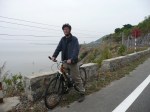
Our final day promised more action, though happily it was not as strenous as the trek! Some of the nine who’d stayed two nights were going straight back to Halong City for a bus connection to Hanoi, and were facing an entire day of travelling by slow boat and road. The five of us doing the adventure tour instead stopped at Cat Ba town for a while to have a look around, then were driven to the Hospital Cave. Built with Chinese help during the 1960s, it comprises nearly two dozen concrete rooms built inside a large natural cave that served as a bombproof wartime hospital and refuge for leaders of the anti-American forces. It was interesting enough, but would have been much better if the rooms were furnished with examples of what each room was used for; bare concrete cells did not convey much at all. Afterwards we mounted bikes for an exhilarating 14-kilometre ride to the coast, with a couple of tough hills but also lots of fun downhills to hurtle down. Finally a good lunch at a pretty waterside restaurant, then a fast hydrofoil ride to Haiphong before transferring to a minibus for the trip back to Hanoi. Well organised at every step and good value for what was offered, I can heartily recommend Ocean Tours if you want to visit this part of Vietnam.

Categories: travel, Vietnam | Leave a comment

Create a free website or blog at WordPress.com.

Design a site like this with WordPress.com
Get started