Laos

Slow boat to Nong Khiaw

The slow boat to Nong Khiaw is an enchanting journey, offering just the right combination of sensational scenery, worthy discomfort, local colour and serenity. It’s probably one of the nicest river trips you can do in Laos, at least at this time of year.

When I booked the ticket I asked how many people the boat could hold at most and was told “15”. This pleased me, because I have read blog posts about the much more popular boat from the Thai border to Luang Prabang and heard some horror stories. Packed in 70 to 100 per boat, that journey takes two days with an overnight stop in the traveller hell of Pak Beng where ripping off the tourists is apparently a local sport. Some say it’s pleasant enough, others hated it, very few say it was a highlight of their trip.

The contrast with the boat to Nong Khiaw could not be greater. In fact our boat could take only 10 people, but in this case our group of 12 was split into two very small boats so we all had ample room to relax in. Such a small craft is necessary because at this time of year the river level is quite low, and anything larger would probably have got stuck on a rock somewhere (or worse). Being on a small boat gave a very intimate connection with the surroundings and people we passed, and it was such a thoroughly peaceful journey that the seven hours passed quite quickly.

I don’t mean it was peaceful in a literal sense, of course. The constant clatter of the engine made conversation very difficult, but in every other respect it was totally relaxing. Not that it was luxurious, either: the low wooden stools (very similar to those you would have sat on in kindergarten) we could sit on were so hard that it was actually much more comfortable sitting on the floor, and nearly all of us rotated between stool and floor as necessary. We only had a couple of pit stops to take a pee behind a bush on a riverbank – not once did we pass a village where we could stop for a meal, drink or proper toilet.

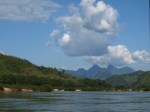
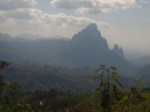
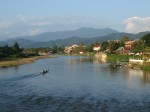
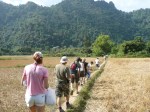
The scenery ranged from merely pretty to spectacular, with some magnificent high cliffs passed on several occasions. The terrain was almost entirely forested, though from time to time a riverside village could be seen high on the banks, with children playing on the shore and men fishing in the water. A couple of large bamboo barges floated by, as did a number of fishing skiffs and other small passenger boats heading south. Our pilot was expert at guiding us through constant hazards such as submerged rocks, floating trees and even up some rough rapids, and never once did I feel like we were in any danger. Even though the six initial passengers were all western tourists it had a genuinely local feel, a fact confirmed when a man hailed us from the river’s edge at one point and got on board with his baby daughter and a sack of food. I had brought a book along as I feared it would be a dull journey otherwise, but I spent far more time simply admiring the view and taking shirtloads of photos (which I’ve edited down to fifteen highlights – check my Photo Gallery in a couple of days if you want to see them all).

Arriving in Nong Khiaw was something of an anticlimax. It’s much smaller than I expected, and more rustic too with rocky unpaved streets and a small selection of somewhat over-priced guesthouses. I’ve found a riverside bungalow with great shared balcony that overlooks the town, and though it’s comfortable enough with private hot water bathroom and western throne I’ve gotten much better rooms for the same money elsewhere in Laos.

A final drawback of Nong Khiaw, and much more serious, is that there is no ATM or bank here – not even a money changer. This has caused me to alter my route a bit, as I don’t have enough local currency on hand to get me through the next two days, let alone the next two weeks (I do have US dollars as a backup, of course, but not enough for my needs). It seems that outside the tourist triangle things really are less developed than I’d come to believe, and I simply can’t go further north without an adequate supply of cash. The nearest place where I know for sure there is an ATM and other banking facilities is Oudomxai, about four hours west by bus. I had intended to skip it entirely but will now have to visit there because I can’t risk running out of money! It doesn’t matter too much, and in fact it allows me to see more of Laos than I intended which is really a positive in the end, isn’t it?

Categories: Laos, travel | Leave a comment

Luang Prabang

My first impression of Luang Prabang is that it’s nothing like the rest of Laos, rather it’s like most westerners imagine or want it to be. It’s well and truly on the world tourist circuit (it even has an international airport, the only other one in the country apart from the capital), and a huge number of businesses exist solely to service that market. But despite the consequent hordes of tourists it’s definitely a great place to relax and rest up for a while…

The tourist heart of town is a small finger of land – almost a peninsula – surrounded on three sides by two languid rivers. The streets are very different from what I’ve seen elsewhere in Laos: for a start they’ve got kerbs and gutters running down both sides, and they’re very clean. It seems like almost every building is a guesthouse, restaurant or traditional massage place and they’re mostly housed in beautifully restored houses in French or Lao style. The main roads are narrow and the lanes narrower, and in between it all are more than a few temples large and small. It’s an extremely peaceful place, too, with no traffic at night and nearly everything closing by 11pm.

Outside the centre it’s much more like the rest of the country: busy, dusty, few gutters on the streets, shopfronts open to the street, roadside stalls. The countryside is particularly beautiful, with small crop fields nestled wherever possible on flat land beside the rivers. However because I will be seeing a lot more of rural areas shortly I’ve stayed almost entirely in the old town, where my well-appointed guesthouse is located in a quiet alley near the working temple of Wat Nong. Yesterday morning I was awoken gently at 4am by the first bells that rouse the monks for their day, and I contemplated the complete stillness of this place at that time… before going back to sleep to wake later at a more sensible hour.

My first full day was spent wandering around, trying to take some nice photos and finding a working internet connection to keep in touch with the world. I also made some inquiries about further travel north, as I really want to take a boat for my next journey to Nong Khiaw. Happily this option is more common than than it was a few years ago, and I’m now booked on Monday’s slow boat north. I also picked up a new book to read on the journey (Stieg Larsson’s The Girl With The Dragon Tattoo) and succeeded in finding a cooking course that appealed, which I attended last night and which I’ll post about separately soon. It was good fun and very useful: if you want to experience a bit of a Lao feast, get in touch with me when I return and I’ll see what I can do 😉

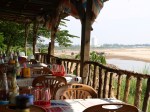
Today was meant to be relaxing, with the simple goals of getting a massage (for A$6 an hour) and practicing some Lao. It turned out to be even more sedate: after waking late and finally getting the guesthouse’s wifi to work, I had a late breakfast then wandered to an open-air restaurant around the corner that perches prettily on the banks of the Mekong. I took a book and picked a table with a fine view several kilometres north up the river and settled in for three hours of reading (Stieg Larsson is brilliant), munching on my favourite local dish of oh laam pa (a fragrant hot-bitter stew of eggplant, basil, galangal, chilli, beans, chicken and a local herb which gives it a slight medicinal quality) with sticky rice at some point. Then back to the room for a nap, then off to a high-speed internet cafe to do some skyping. Then back to the guesthouse for a short while, and now in the evening to a lovely French brasserie with wifi that’s also very close to my guesthouse. I’ll do this post then keep reading, then have a good French meal before heading back to pack for tomorrow. I’m so mellow that a massage would be redundant today 🙂

In Luang Prabang I’ve followed my usual pattern when I arrive in a new town with the aim of doing not much. The first day is spent wandering around, perhaps doing some necessary shopping and chores (eg. deodorant, laundry, decent internet connection) and seeing a sight or two. After I’ve got my bearings I tend to stay very close to my guesthouse if it’s a nice area, which this part of town certainly is. Over the past two days I’ve started to notice the local families who live amongst the guesthouses and restaurants, who go about their lives quite publicly in the front section of their house that is usually open to the street during the day. As today’s a Sunday virtually everyone’s been relaxing as well, lazing on the porch chatting, playing with pets, or dozing. By doing next to nothing I’ve picked up a little extra flavour of this place without any effort, and I’ll have fond memories from here in the future. That’s the real joy of extended travel like this: you can take the time to chill out whenever you want, and there’s no pressure to keep moving or tick off sights mechanically. And I’m only just into week three – there’s still another three and half months to go!

Categories: Laos, travel | Leave a comment

Road to Luang Prabang

Well that was the most memorable bus trip I’ve ever taken. It’s 230 kms by road from Vang Vieng to Luang Prabang, and the journey is scheduled to take about seven hours. Do the math: that’s just over 30 kilometres an hour. The guide book recommends travellers prone to motion sickness take appropriate precautions. I can now see why…

It started quite amiably, with mostly flat roads and modest traffic for the first 56 kms to Kasi. After quite a long pit stop we board again for the long, steep, twisting, bumpy journey through some of the most spectacular highlands scenery I’ve ever witnessed. We slog upwards for over two hours, including one stretch grinding uphill in second gear continuously FOR AN ENTIRE HOUR. Can you imagine what that’s like? It’s bone-jarring, brain-numbing, and ear-rattling too if you’re right above the engine like I was. It gives a whole new dimension of meaning to the phrase “are we there yet?”.

All the way up we pass hillside villages, furiously poor places where most homes are single-room affairs with the walls made of overlapping leaves and the roof of thatch, though some also sprout satellite dishes. Where countless kids play on the road while trucks and buses pass, where parents wait behind roadside stalls trying to sell carefully gathered bounty from the hills. Everywhere are trays of tiny red chillies and mats of grain by the road to dry in the sun, and picking up a lovely patina of road dust and fumes in the process. After three and a half hours of this… we’ve come halfway.

The next section is less scenic but still rugged and winding, and my head lolled from left to right so much that I forgot what felt like to travel in a straight line. Conversation was futile above the engine’s constant growl, and sleep impossible for all but the most experienced or knackered. All we could do was stare out the window at the wild hills of northern Laos. Unless you’re me, who started typing this on the bus one-handed (because I needed the other to stop my laptop flying across the aisle). Eventually I got tired and started to doze, when suddenly we stopped for another break at a clifftop roadhouse of sorts. Just enough time for the vibrations to leave the body, then back on the bus for a rapid but still twisting descent to the lowlands. Once on the river delta villages become prosperous again, with markets, restaurants and solid houses of brick and tile, and small crops growing where they can, then finally to Luang Prabang itself.

Memorable but arduous, and this was a relatively comfortable journey in a full-sized touring bus with reclining seats (though it was forty years old if it was a day), on paved roads in good weather. Much more extreme travel lies ahead: bumpy dirt roads over the hills to the north, probably in a saeung-thaew (a pickup truck with two bench seats running the length of the tray – usually covered). I may look back on today’s journey wistfully in the weeks to come!

Categories: Laos, travel | 2 Comments

Vang Vieng

You have to adjust to very different concepts of acceptable risk and safety on the road in Laos. The bus ride from Vientiane to Vang Vieng was a real education about travelling here, and I can see now why you should only plan to go no more than 200 kms a day here (unless you want to spend an entire bum-numbing day on the move).

For a start, everything moves S-L-O-W-L-Y. The fastest speed our driver managed to hold for more than a minute was 60 kmh; often it was only 30-40 kmh. Why? Because all manner of vehicles from bicycles to scooters to tractors to trucks share the single-lane-each-way road, so half your time is spent behind someone waiting to pass. The road surface is far from perfect, either: even on central Route 13 there were enough potholes and bumpy sections to make high speed travel impossible.

And what is considered normal here is amazing compared to the safety-obsessed culture in Australia… schoolkids riding their bikes four abreast, taking up fully half of the road and ambling along as if down a country lane (not a major highway); mothers riding a scooter without a helmet, their toddler wedged between the handlebars in front of them; fathers riding a scooter without a helmet, with three young kids squeezed behind him in a row; cows and chickens grazing contentedly on the road’s edge; buses so ancient, decrepit and slow that it’s a miracle they can move at all; a child barely three years old riding a toy trike on the edge of the highway without a parent in sight; 10-year-old boys on motorbikes without a helmet; an old man sitting on the apex of a tight bend, oblivious to the buses and trucks passing; cars overtaking buses overtaking trucks, sometimes on blind corners; pedestrians walking along the highway a full metre or two from the verge (ie. on the road itself), not bothering to move over even when an approaching vehicle toots its horn to say “get out of the way”. There appears to be complete faith that faster vehicles will simply go around them, so why bother moving over? Road accidents are a major cause of death and injury in Laos.

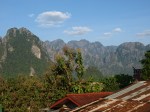
Fortunately our driver was careful and we made it safely to the backpacker oasis of Vang Vieng. This place has become legendary since Laos was opened to tourism in 1989: floating down the river in an inflated tractor tyre tube (optionally on any number of drugs) has become a “rite of passage” for Asian travellers, or so says Lonely Planet. It’s not quite as overwhelmingly a “party” town as I expected, though uncontrolled western youths can be found in their natural habitat if you look hard enough. What I wasn’t prepared for is the spectacular mountains that surround the town: jagged forest-covered karst peaks rise up all around you, especially just across the river that runs past the town. Vang Vieng is now the adventure tourism hub for the whole country, and you can take your pick from numerous tubing, kayaking, caving, rock climbing and trekking tours on offer.

I opted for a full day tour that visited some caves, then lunch, then a walk through a local Hmong village, then kayaking 8 kms down the Nam Som back to Vang Vieng. The caves were interesting and the bbq lunch good, but the standout highlight was the kayaking. When I booked the tour yesterday there was only one other person signed up, an American woman called Liz. But by this morning nice others had joined us, however when it came to sharing the two-person kayaks it was natural that Liz and I shared a ride. We turned out to be a good team, and rode the gentle rapids with ease as we floated through the steep sided cliffs and lush green banks. It was a load of fun, most of all when we passed through the launch point for the tubers. Half a dozen riverside bars vied for custom by trying to outdo each other with the volume of their music, rope swings over the water and waterslides, not to mention beer and drug options for those who wanted to float down in every sense of the word. We slowed down to the speed of the current for this, as it was fascinating in its extremity… surely such hardcore partying gets exhausting after a while? Anyway things calmed down after a few hundred metres, and I was glad to have a paddle in my hands after another kilometre or two (tubers are left to the current to get home, and many of them looked over it well before the end).

I wish I had another day to stay here to hire a bike and explore the local area, but I’ve booked a few nights in the temple town of Luang Prabang starting tomorrow night so I must move on. Another long bus journey ahead (230 kms, expected to take 7 hours), then it’s off the mandatory tourist trail of Vientiane-Vang Vieng-Luang Prabang and into the wilds of the north 🙂

Categories: Laos, travel | Leave a comment

Vientiane

It’s hard to believe Vientiane is a capital city. In fact having been here for a couple of days, I still can’t really believe it… such a laid-back and slow-paced place should be a provincial town, not the administrative centre of an entire nation. But it’s relaxing atmosphere bodes well for the travels to come 🙂

After an excruiciating hour getting through immigration at the airport, the stress evaporated immediately upon leaving the airport. A tip for future travellers to Vientiane by air: get your visa in advance if possible. “Visa on arrival” sounds nice and easy, but when fully half the plane is trying to get one with you it can be quite a wait! Outside it was remarkably cool, perhaps 17 degrees, which none of us expected. Taxis for the short trip to the city are relatively expensive at US$6, but I teamed up with a couple of Norwegian women who were on their way to the bus station so it worked out nice and cheap into town.

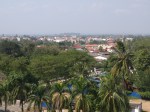
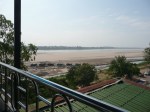
Immediate impressions of Vientiane: slow, dusty, lazy, sandy, friendly, peaceful. It’s a very compact town that is completely accessible on foot, though the tuk-tuk drivers will chirp “tuk-tuk! tuk-tuk!” at you whenever you walk by. My hotel room wasn’t ready when I got in, so I wandered the centre of town for a while and ended up having an excellent green chicken curry and of course a beerlao while waiting. After freshening up in the room I wandered some more, but quickly discovered that the best place to hang out is the rooftop terrace bar at Bar Pen Nyang, where under the cover of a high ceiling you get magnificent 180 degree views of the Mekong and the Thai shore to the south.

This is quite a tourist town these days, with countless restaurants, bars and guesthouses catering to the western wanderer. I’ve met several travellers who say it’s very different from just 3-4 years ago, and if you were last here more than a decade ago apparently you won’t recognise the place. Prices have risen considerably: the “current” Lonely Planet guidebook (which everyone is using, including me) is now almost three years old, and many prices, especially accomodation, have doubled in that short time. I also have the brand new “Greater Mekong” LP guide which was released just two months ago and is much more up-to-date, though even that is slightly out of touch with current prices (at least in Vientiane). That said it’s still a wonderfully cheap place to visit: a longneck of beerlao costs between A$1.10 and A$2.00 nearly everywhere (pub or restaurant price; takeaway is even cheaper), and you can get a very decent feed for just A$3-8. For example at Bar Pen Nyang I had a whole river fish, huge and succulent, steamed with lime and chilli and served with rice for just A$4. The most common group of tourists are Europeans, especially Dutch and French, followed by British and Canadians, though I have by now encountered a few Aussies and Kiwis too.

I found it hard to find a cheap place to stay here while researching from Malaysia. Whenever I arrive in a new country by air I like to have at least the first couple of days organised staying somewhere nice – once there I can wander around and find the good but cheap places personally. I lucked out big time with the Inter City Hotel, which is highly recommended if you only want to spend a few days in Vientiane. Decked out with lovely local wooden antiques in the foyer and polished floorboards everywhere, I’ve got a huge room with large modern bathroom, aircon, satellite TV, twin beds (both king singles) for A$38 a night. That’s still pretty pricey in this town but well worth it, as it includes an extensive hot buffet breakfast and is incredibly central to everything. I’ve got a room at the back which is great because you don’t get any noise at night, and though I initially booked for three nights I’ve extended it for my entire stay here because it’s so peaceful.

Some vignettes of my time in Vientiane:

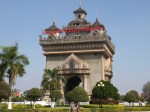
– Visiting Patuxai, the Arc d’Triumph-like structure just north of the city. This attractive edifice looks like it’s been here for ages but in fact it was only built in the 1960s with concrete intended for an airport, hence it is also known as the “vertical runway”.

– Simply wandering the streets. There aren’t many of them in the centre of town, and it’s completely coverable on foot. That is always my preferred way of discovering a city and Vientiane’s streets are a delight to stroll.

– The Thalat Sao markets get the hype, but they’re really just like Paddy’s Market in Chinatown (though you can also buy whitegoods such as air conditioners and washing machines). Much more interesting are the local markets across the road behind the bus station: dirty, dusty alleys where every possible essential good you can imagine is on sale. The food section was particularly interesting, with dozens of women offering fresh food on their blankets, all covered by a cloth ceiling so low that I had to stoop the entire time.

– going to a secondhand bookshop to stock up on reading material for the week ahead, and being able to trade in my (now unnecessary and almost out-of-date) LP guide to Malaysia and Singapore. Net cost for two novels: A$3. I was able to finish one of them in just five hours: Mike Gayle’s Wish You Were Here, a gentle read about three thirty-something British guys suffering various life crises who go on a holiday together to Crete. Featuring drama, booze, a sex-triangle and ultimately redemption through love, it’s a very engaging travel book that suited my mood perfectly.

– The Lao National Museum is a rather rustic affair with some fragments of pre-historic life and an extensive display of the 20th century history of the nation. It’s very patriotic with phrases such as “the American Imperialist and its puppets” used liberally, and many of the weapons employed to free the country from colonial rule are on display.

– Being offered opium by a tuk-tuk driver while walking some of the backstreets north of the city. Drugs are technically illegal here but widely available if you want them. I declined, of course, as I did another tuk-tuk driver who promised me “lots of girls” the night before. Vientiane is a far cry from the city it was in 1975 as described by Paul Theroux in his book The Great Railway Bazaar, where “the brothels are cleaner than hotels… and it’s easier to get opium than a cold beer”, but it still has an “anything goes” vibe that is very enchanting…

– Sitting at the temporary stalls on the bank of the Mekong in the evening, where dozens of vendors set up plastic chairs and tables to capture tourists wanting to view the sun set. It’s nice, but a much better option is crossing the road and going up to the fourth floor terrace of Bar Pen Nyang where prices are about the same but the food is considerably better, as is the atmosphere and the view.

– Getting a traditional Lao massage for A$5-8 an hour. Swedish oil massages are A$10-12. Heaven!

– After several very quiet nights in, I headed to Bar Pen Nyang again last night for dinner and noticed a young woman with her head stuck in the LP Laos guide. I knew her boyfriend was playing pool so this was not a come-on, but I went up to her and started chatting because I was genuinely interested in where they’d been and where they were going. Laura and her man Jan turned out to be a lovely Belgian couple who had recently come down from the north and had some useful advice for my intended travels there. Jan visited Laos four years ago and he said it had changed enormously in that short time: “much more touristy” in his opinion. The roads in the north have been upgraded by the Chinese who want access to resources, which makes travel there much much easier than it used to be. A bit later a friend of theirs, an Australian called Dean, rocked up unannounced because he knew that there’d be someone at Bar Pen Nyang that he knew… he’s a very well-travelled and likeable guy and after a while we all decided to carry on to another bar nearby where live music was playing. That turned out to be a dud (think seedy sex-tourism vibe – yuk), but by this stage we wanted to carry on so we headed by tuk-tuk to the huge Don Chan Palace Hotel in search of a casino (Dean’s call, not mine!). We didn’t find the casino but did discover a nightclub very popular with locals, and ended up drinking, dancing and chatting ’til the wee hours. Top night, but sore head today…

It would be very easy to stay here for a week or two, indulging oneself in Vientiane’s beguiling charms. But the road beckons: tomorrow I’m off to Vang Vieng for a couple of nights, then Luang Prabang, then I venture off the mandatory tourist trail to visit the far northern reaches of Laos where I hope to go trekking near the Chinese border 😀

Categories: Laos, travel | Leave a comment

Blog at WordPress.com.

Design a site like this with WordPress.com
Get started