Laos

Savannakhet

Soon after boarding the bus from Tha Kaek to Savannahket I mused that of all the bus journeys I’d taken so far in Laos, nothing had gone wrong. Sure there was the landfall that blocked the road for a few hours on the way to Dien Bien Phu, and yes some trips were hellish, but none of the buses had actually broken down. I should have known better than to tempt fate…

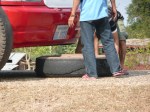
Suddenly I was ripped from my doze by the sound of a loud bang! directly underneath me and swift deceleration as the driver hit the brakes. A tyre had blown out. Fortunately there were two tyres on that corner so we didn’t lose control, and luckier still we pulled to a stop right outside a roadside shop so cool drinks could be had while the tyre was changed.

Savannakhet proved to be a little disappointing. Not for the town itself – it’s one of the more prosperous and populous parts of Laos, and earns a tidy living from the sea of trade that flows through here between Thailand and Vietnam. But I’d deliberately aimed to be in this larger town because I wanted to be somewhere busy with a good concentration of other westerners for New Year’s Eve. I’ve been rather remote of late, and was craving familiar company for a while…

But my new year experience was not what I expected. After wandering the streets and several restaurant/bars I saw almost no other travellers. Even the guesthouse I was staying at, which had promised a celebration for its few guests, was a dud with noone else showing up! But the town was certainly busy, and NYE was a much bigger affair locally than I thought it’d be. Many shops closed early, there were lots of private barbeques and parties going on in peoples’ front yards/terraces, and kids gleefully let off crackers everywhere. I ended up accepting a random invite from a small group of locals who beckoned me over to the table out the front of their shop. My Lao language skills were horribly exposed, but we managed to communicate enough to see in the midnight hour. Lots of beerlao was consumed, with endless toasts and a fair bit of food too. Definitely a different NYE!

Categories: Laos, travel | Leave a comment

Tha Kaek

Tha Kaek is another sleepy provincial capital draped languidly along the eastern shore of the Mekong, where there is little to do except stroll the waterfront and relax. Are you seeing a pattern here? The Lao national emblem should be a hammock.

When I arrived late yesterday I was underwhelmed – it’s nice, but hardly special – and I intended to head off immediately today to the larger town Savannakhet a few hours further south. But on waking I decided I wasn’t in such a hurry, and that I could easily spend another day soaking up the atmosphere here. While it may not be special, it is a pleasant place to hang the boots. Having a nice hotel helps a lot too, of course: from a paucity of quality options the Inthira Hotel is perfectly located near the waterfront, has wifi internet (*usually) and a luscious king-size bed with the best pillows I’ve laid my head on since The Royal Mail Hotel in Dunkeld. Well worth it for just A$22 a night.

The latest guidebook says Tha Kaek feels like Vientiane did ten years ago. If that’s true, Vientiane has changed very rapidly… while a handful of travellers do make it here Tha Kaek is very much a place for locals, and the local economy seems to bustle happily. There are numerous shops offering everything needed for the modern Lao life: mobile phones, scooters and places to service and wash them (these are always busy), clothes, homewares and hardware, kids’ toys, televisions. The tuk-tuk drivers don’t heckle you for rides because they are still a popular local form of transport, and in almost two hours wandering the main streets today I saw exactly three other foreigners amidst hundreds of Lao.

Not much else to report really, but I think you can understand now why I was so obsessed with gathering books while in Hanoi and Vientiane. It’s taken just one morning to see this town, and I don’t fancy doing laps in the heat. Missions for the afternoon: lunch, reading, maybe a nap, perambulating the waterfront, more reading, dinner, and because it’s unlikely I’ll find someone to hang out with tonight probably an early night in, with more reading or possibly watching the box. Ahhhh…. is it possible for stress levels to go negative?

Categories: Laos, travel | Leave a comment

Kong Lo cave

Imagine the biggest, most impressive cave possible. Then double it. Then double it again. Then stretch it out reaaaallly far and run a river through the middle of it. You might now be somewhere close to understanding just how overwhelmingly huge Kong Lo cave really is.

Karst formations dot the landscape of Laos and parts of Vietnam, the remnants of ancient coral reefs and seabeds eroded by the aeons into spectacularly sharp mountain ranges and hills than can run for dozens of miles. The beautiful hills around Vang Vieng are karst formations, as are the world-famous islands of Halong Bay and Lan Ha Bay. Apart from usually being stunning to look at from afar, another common feature of these porous limestone edifices is that they can have deep caves within their bases. However the biggest, baddest and most impressive of all is Kong Lo cave in central Laos. Running for more than seven kilometres beneath a mountain it dwarfs anything your imagination can conceive, and entering its gaping maw is like taking a trip into the Underworld of fantasy and myth…

Getting there is simple enough these days, though few seem to do it on their own, preferring instead day or overnight trips from the bigger tourist centre of Tha Kaek. After being deposited on the highway from the Conservation Centre, I waited for the next passing bus to Lak Sao (near the Vietnam border) and got off at Ban Na Hin. Though there are a number of guesthouses there it’s quite unappealing, and as it was early I decided to go straight to the town near the cave and stay there overnight. I was greatly helped by the french woman I met the other night as she’d told me about a good new guesthouse that was only a short walk from the cave, so I knew I could stay comfortably in the village. I had to wait an hour for the next sawng-thaew to leave, an easy pause, and just before it left a French-Canadian couple joined the ride as well. They had walked around Ban Na Hin and decided they didn’t want to stay there either. Apparently the trip to Ban Kong Lo used to be awful, but late last year a new road opened and it’s a breeze these days. We found the guesthouse without a problem and it was much better than expected: five bamboo and wood bungalows featuring a large hard bed with mosquito net, modern bathroom with hot water and best of all a neat balcony out the back overlooking rice fields to the karst mountains less than a kilometre away. Nestled at the pointy end of a closed valley It’s a very peaceful and beautiful end-of-the-road kind of place, and you can stay there for just A$9 a night. I decided immediately to stay two nights and visit the cave the following day.

Though it’s now a popular tourist attraction the infrastructure around the cave is charmingly simple, with tickets purchased from an old guy sitting under a large canopy. I think the proceeds go directly to the local villages, and the whole operation appears to be run as a semi-collective with an orderly allocation of tourists to boats. Each boat can take just three passengers but you still have two guides, both with a powerful light and knowledge of the cave. This is presumably so that if something goes pear-shaped you won’t be left alone, stranded in the pitch black wondering why you’ve let yourself be led so far into darkness… It’s late and I don’t want to wait for others so I commandeer a boat to myself, and after a short walk past a beautiful lagoon outside the cave’s mouth we enter the maw and board the boat for our journey under the mountain.

The staging point just above some small rapids is like the landing bay of a sci-fi spaceship, a wide, low-domed roof opening to the light of the lagoon on one side and pointing to black on the other. In the boat and we’re away, through chamber after chamber lined with smooth white rock. Some are low with sloping sides that almost brush your head as you pass close to the wall, others are larger than cathedrals, so high that even the beams of the guides’ torches don’t reach the top. It’s utterly entrancing, and you don’t even feel too alone because boats coming back from the other end pass by often. At a few places the water is so shallow that the boat has to be dragged across, and at one point we dismount to wander through a particularly fine collection of stalactites and stalacmites that are artfully illuminated – a surprising touch. Back to the boat and onwards, and it’s easy to lose track of time and space in there. All you know is an endless series of caverns that emerge as the river snakes and winds, the occasional smooth white-sand beach that looks great for a picnic (if you’re into creepy picnics), all to the soundtrack of the two-stroke engine that drives you forward. It’s relentlessly awesome.

We turn a corner and I see what appears to be another illuminated section up ahead. As we close on it I realise it’s actually the end of the cave, and I’m looking at trees and sunlight again! I forego the option of walking to the nearby village so we turn around and head back through again, and it seems more familiar already. This is not just a tourist site: we pass a local boat full of supplies and reclining men on their way to the village which is inaccessible by road.

Now I’m not normally a big fan of caves. The kayaking trip I took in Vang Vieng included visits to three of varying size and difficulty, and at best I found them dull (at worst very uncomfortable). I don’t see the attraction in crawling through a dark, dank space so you can experience emotions ranging from “meh” to claustrophobia; it’s just not my thing. But from now on I don’t think I ever have to see another cave. I’ve seen the biggest and most stunning of them all: Kong Lo.

Categories: Laos, travel | Leave a comment

Nam Kading Research Centre

The World Conservation Society has operated a research centre on the banks of the Nam Kading river for several years, and recently they’ve opened it up to travellers who want to stay there. The guidebook mentions it and it piqued my interest, so when I saw a current brochure about the place in Vientiane I made contact by email. It sounded intriguing: accessible only by boat or a rough road and in a picturesque location on the edge of the Nam Kading national park, it promised basic but comfortable digs from which you can explore the area. I wasn’t sure I really wanted to go until the morning I left Paksan – indeed I didn’t really make the decision until I was standing at the bus station…

It was worth the effort. My first trip on a sawng-thaew, a flatbed truck converted to carry passengers with two benches running lengthways down the tray and a canopy above. It’s the most common form of transport in rural areas, best-suited and most frequently available for journeys of up to 50-100kms, and I’d seen them all over northern Laos but never had the need to catch one before now. After jumping off at Ban Nongkham, a tiny speck of a settlement barely worth a name, it was a short trip on the back of a motorcycle (I was too lazy to walk it) to the banks of the river, where for 80,000 kip ($11) a longtail boat took me upriver for half an hour to the research centre. The centre has the feeling of a school adventure camp, situated high on the riverbank with several raised wooden buildings in a gentle forest glade. The pristine Nam Kading river can be seen through the trees, and the “Boys Own” feel was accentuated by the three young male staff on site. I was the only guest staying there that night, it turned out.

After settling in to my room – I had the pick of eight identical cells each with two single beds, mosquito nets, pillows, blankets, and nothing else – I asked for some lunch as I hadn’t had breakfast. There was no menu offered, I simply heard some chopping and frying taking place in the open kitchen underneath one of the huts (it turned out to be a tasty mix of sauteed shiitake mushrooms, fried eggs and sticky rice). While it was being prepared the head guy there, a boy-man called Khong who was probably twenty-something but looked younger, began his soft-sell about the various treks they have to offer. None of them really appealed, especially as the supposed highlights were a couple of waterfalls that looked like small rapids (at best) from the pictures. Even with my new-found adventure focus I don’t want to traipse through remote jungle unless there’s something worthy to look at! It made me wonder just how much research is actually done at this place, though to be fair it was the day after Christmas and most of the normal crew were probably back home with their families. I chose instead for the low-key option of being boated upriver a short way to the nearest “waterfall”, and then tubing back. I use inverted commas for the “waterfall” because while it’s big enough to prevent a boat going upriver, it doesn’t fall that far. Two metres, actually, hardly a big attraction in my book but it was located in a picturesque part of the valley. Getting there involved scrambling over rocks for quite a while, and the tubing started with a leap off the edge of the falls into the cool water below. We didn’t float very far downriver, but it was fun while it lasted and much more relaxing that doing the same thing in the tubing heaven/hell of Vang Vieng.

That was the highlight of the day, in terms of action. Because I didn’t want to trek the boys left me to my own devices, and I happily sat at an outdoor bench overlooking the river and started a new book. The peace was almost complete, broken only by different birdsongs and a very occasional engine rumbling past the road behind the camp. Dinner was served early at 6pm, and all four of us tucked into a simple but delicious meal of sauteed cauliflower with shreds of beef, fried egg, sticky rice and mushroom soup with lemongrass. I crashed out very early, and later I heard some motos arrive as the boys had some guests from the nearby village over. Guitars were brought out and I was tempted to join, but an unexplained fatigue took me off to sleep before I could act. Waking the next morning I was still tired, and somewhat cold as a powerful wind had developed overnight and was still blowing hard. Breakfast was yet more sticky rice with fried egg and diced beef, then afterwards another boat and moto trip back to the main road to head further south. The Nam Kading Research Centre was an interesting and definitely off-the-beaten-track place to stop, though I’d recommend it only if you have oodles of time to spare or are very keen on getting into the wilderness of central Laos.

Categories: Laos, travel | Leave a comment

Paksan

Getting to Paksan was by far the best bus journey I’ve had so far. After a couple of weeks of being in big cities and hanging around lots of other travellers, I felt a strong urge to get away from them all as far as possible. Which made my choice of transport a no-brainer when I wanted to head to south: local buses all the way.

There are numerous “VIP” buses and minivans that offer to deliver you in relative comfort from Vientiane to the tourist hotspots of Tha Kaek, Savannakhet and Pakse, and they’re all good value. But they are almost entirely patronised by westerners, many of whom don’t have the time to visit the spaces in between. I was looking for a different experience this time, and the VIP buses also leave very early in the morning which did not appeal at all. So I rose when I felt like it, did some Christmas Day contacting and then got a tuk-tuk to the southern bus station. There was a local bus leaving to Paksan in half an hour – perfect. And it was dirt cheap: the 9km tuk-tuk to the bus station cost 50,000 kip (A$7), whereas the 100km+ journey to Paksan cost only half that 🙂

The bus left exactly on time, which was a bit of a shock. But we only made it two hundred metres before it slowed down to let more than a dozen hawkers on board. They agressively went up and down the aisle trying to flog drinks, chewing gum, books, barbequed chicken, sticky rice and more, and it was another twenty minutes before we set of in earnest. Stopping frequently to pick up more passengers on the way, the conductor got increasingly creative with the seating arrangements as the bus filled. When every seat was taken, he produced from nowhere a large plastic stool so the next guy could sit in the aisle in comfort. When more got on, they were directed to the lumpy sacks filling the back half of the aisle. Later arrivals simply leaned against the nearest post. I was the only westerner on board, and I was joined on my seat by a young man who was returning to his home village just south of Paksan. He’d been competing in the South East Asian Games which have just finished in Vientiane, and he’d won his division of boxing. He was very proud of the fact and discreetly showed me the gold medal hidden in his beltbag.

Once out of town the ride was a dream, and completely different from travelling in the north. The road is flat, straight, paved and almost bump-free, which mean we could overtake safely and travel at the rare speed of 50 kmh or more! Several times we slowed to pick up or set down, or to invite more food sellers on who hawked their wares as the bus slowly rattled a few kilometres down the road. They got off well away from their start point, presumably to wait for the next bus heading the opposite direction so they could try again. The bus was ancient, of course, but it was still kitted out with a television and dvd player in the console above the driver’s head. That’s one thing I’ve noticed here: no matter how old the bus, how crappy the seats or how rough the suspension, Laotians certainly know how to wire together a sound system. Even on the juddering ride to Phongsali there was an old amplifier strapped beside the driver, and quality speakers lashed to posts throughout the bus. They sounded fantastic, burrowing the Lao and Thai pop that was blaring away endlessly deep into your head. It’s not as awful as it might seem.

Arriving in Paksan earlier than I expected, I wandered from the bus stop to where a decent guesthouse and restaurant were supposed to be and took stock of the place. My guidebook is dismissive (“we’d like to say there is nothing much to see in Paksan, but that would be overstating it”), but for my needs at the moment the fact it’s right is not the point. For a change I was looking for somewhere that tourists barely notice, let alone stop in, and this fits the bill perfectly. It’s actually the first place that’s made me think of an Australian country town. Situated on a flat plain and broadly distributed around a river crossing, the main road – the highway – has shops and other services spread distantly along its length, and the side roads are wide and quiet. There are suburban houses (or the local equivalent of, anyway), even picket fences in places, and further from the main road are pastures, crops and sparse bush. And it’s hot. If I start seeing cattlemen in Akubras walking down the street, I’ll lay off the Beerlao for a while.

later…

Walking down the road a few kilometres to the river. Kids hurtle past, rushing away from school on scooters. By the rushed shore of the wide, languid Mekong two women tend fishing nets in the afternoon sun. Thailand nestles prosperous on the far shore. Past a large field where youngsters play volleyball watched by their parents, Christmas carols blasting loudly from the sound system. In English. I remember from the guidebook that this part of Laos has a high proportion of Christians, improbably. It feels like any other country suburbia. I see no westerners apart from an older woman with cropped blonde hair riding past. We wave at each other heartily – perhaps she’s the French woman who’s also staying at my guesthouse tonight? We carry on our ways. Later at the nearby restaurant, reading, sipping a cool beer in the dark evening. Later still some outstandingly fresh fish, battered and deep fried. Cut vertically to make the bones easy to avoid, it’s delicious. Now I know why a constant stream of people drop by to pick up takeaway, the oil’s sizzle heralding the despatch of yet another meal. A brief chat with an older man who installs solar panels up and down the country. He wonders why am I not celebrating Christmas today? Back at the guesthouse I sit on the balcony writing this post. Pop music wafts loudly from a neighbouring house, muted by the shrill of crickets. From the gloom a figure approaches: It is the french woman, the same one I saw this afternoon. We sit for several hours chatting about our travels and I get and give lots of useful advice. When we part at 11.30pm the music from the nearby house has been replaced by an indistinct low male voice. It is a wedding, I’m told. Back in my room I finish my book: William Boyd’s well-written but somewhat unsatisfying Brazzaville Beach. Tired, sleep comes quickly, a calm, fulfilling rest. Tomorrow will be even more remote.
Categories: Laos, travel | Leave a comment

Blog at WordPress.com.

Design a site like this with WordPress.com
Get started