A very experienced traveller I met near Kong Lo cave said that it’s always the difficult journeys that are most memorable. He was suggesting that if I took a less-travelled route through eastern Laos it might be tougher but I wouldn’t regret it, though in the end I opted for the easier western option. But I knew instinctively that his advice was correct; and over the past couple of weeks it’s been proven time and again. We have had three tough travel moments in Cambodia that neither of us will ever forget…
Pear #1: Siem Reap to Battambang
Lonely Planet describes the boat journey from Siem Reap to Battambang as a very scenic journey, calling it “Cambodia’s most enchanting boat trip”. Quite a wrap, don’t ya think? Even though it’s much slower than and four times the price of the bus, both of us were tempted by the beautiful-sounding option. Some of my most memorable trips in Laos were by river, so surely Cambodia’s river “highlight” would be worth the effort? WRONG. It may be very different in the wet season (I certainly hope so), but in the dry this trip is long, unattractive, hot and excruciatingly slow. In fact we were lucky not to stranded on the riverbed in the middle of nowhere.
We weren’t alone in being tempted by the hype. The boats used for this journey are quite large and can carry almost fifty people, even though there are only enough wooden seats for about thirty people (the others sit on ledges or the roof). Apart from one local person every passenger on board was a western tourist. Our day had started very early with a minivan pickup at 6am, which after rounding up a few more travellers dropped us off at a travel agent for breakfast. Then an almost half-hour bus trip through the suburbs to the landing, where we waited again until the boat was full. By the time we finally departed we’d been up for more than two hours, but as we’d been told the journey should only take six hours at most we expected to be in Battambang around 2pm giving plenty of time to see some sights before dinner.
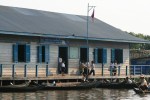
The early phase of the journey was straightforward, taking us quickly to the enormous Tonle Sap lake that lies at the centre of Cambodia. Stretching for more than 100 kms and over 20kms wide at some points, this inland sea is a crucial source of water and fish for large numbers of the population. After an hour we arrived at the western edge of the lake and entered wetlands famous for their bird life, the light was great for photos and the river lay ahead. Quite soon we passed a large and prosperous floating village that extended for a couple of kilometres along the river, with countless photo opportunities of the houses, shops, workshops etc that quite literally float on the water. The river height varies so much between the wet and dry seasons that land settlements are nearly impossible to maintain here, and the only permanent structures around were a handful of solid wooden or concrete administrative buildings on stilts more than six metres high. Schools, small retangular paddocks of plants and even a church were some of the more unusual floaters noted! This village was colourfully painted and clearly received significant foreign aid support (from the signs proclaiming various donors), the people were very friendly, the healthy-looking kids laughing and smiling and waving as we passed.
Unfortunately that was the highlight: it was all downhill at a rate of knots from there. Over the next couple of hours we passed several more floating villages of varying size, but all with decreasing levels of prosperity. The colours faded, the building materials gradually shifted from wood to thatch, the smiles became less enthusiatic as we passed. In between the banks of the river were far from scenic: a monotonous continuity of green shrubs and mangroves that got dull very quickly. The river was slowly narrowing too but I didn’t think much of that at the time, as we were still snaking along at a fair speed. Around the four-hour mark we stopped for lunch at a floating restaurant offering very humble fare of rice with your choice of veges, sausage or egg. The melee for food was a bit chaotic but we managed to scarf down rice with egg and soy sauce and buy some drinks – thankfully. It would be dark before we were able to have another meal…
We entered a narrow channel that just kept getting narrower, our speed dropping to crawling pace at some points. I assumed this would be just a short section that would soon open up again so we could pick up the pace…. nope. Narrower and narrower, slower and slower, the banks covered in even uglier scrub than before and so close we could almost reach out and touch it. Remember this was a boat that can hold fifty people, which means it is long and wide and must displace at least a few feet even without a keel. All the other boats we passed were barely larger than canoes, at most flat barges able to carry ten people plus some cargo. They were appropriate for the conditions; manouvering our behemoth was like trying to drive a semi-trailer along a goat track. We were going so slow and turning so often that we were often being overtaken by our own bow wave, and I began to fear that we would be grounded if the river didn’t widen soon. After more than an hour of this I was sitting on the roof as the lack of airflow downstairs was stifling despite the open sides, but the heat of the direct sun upstairs was oppressive despite a wide hat, long pants and sunscreen. From up the top I had a clear view of how tight things were becoming, and eventually it happened: we grounded on the shore after a particularly tight bend, with nothing around us but flat scrubland as far as the eye could see.
The crew of three tried everything possible to free us using poles, massive revving of the engine, even trying to rock us from side to side. I heard later that some burly passengers downstairs had offered to help but were waved away. After almost half an hour we were suddenly free and resumed our tortuous journey upriver. The only local passenger on the boat came up to the roof for a cigarette and said that just two weeks ago a boat that he was on grounded so hard that the captain ordered every passenger to get off the boat and help push. I honestly thought we were going to have to do the same. I asked him how long we had to go from here? “Oh ages, at least three or four hours to go”. Does the river widen soon? “No. It’s like this all the way to Battambang”. Wonderful. It was quite possibly the most un-scenic river view imaginable: the water brown and muddy, with dead fish occasionally seen floating in the reeds. Dull green vegetation flanked most of the time, but there were occasional flat patches inhabited by the most extreme poverty I have ever personally seen – anywhere. It would be too charitable to describe the things some people were living in as shacks: whole families were living under low domed structures made of twigs and discarded plastic sheeting. Sometimes it was little more than a lean-to beside an open fire. These communities clustered in small groups along the bank, the adults mostly sitting or resting while small kids played amongst the mud and rubbish. We were miles from the nearest road so this was their home for the moment, and being clearly itinerant (where do they go in the rainy season?) I don’t think any government services or NGO aid reaches them. Utterly depressing.
-
-
floating school
-

-
schoolkids
-

-
local knowledge
The best bit about the remainder of the trip was talking to the local man about the less obvious aspects of modern Cambodian life. His english was excellent and he was keen to chat, and gave numerous insights and opinions: most Cambodians welcome the money and development that tourism brings, but they don’t like the consequent rise in prices; they don’t like the fact that the US dollar is increasingly replacing the Riel as the dominant currency; the Police checkpoints I see on roads throughout the country really are naked shakedowns for money from passing motorists. He explained the economics behind our present journey: with 40+ passengers the boat owner’s revenue per trip is around US$800, and his expenses would be no more than $250. So every day he makes more than $500 pure profit. He could shift to two smaller boats that would navigate the low river much more easily but that would decrease his profit, and as virtually none of his passengers are repeat customers he had no incentive to improve the service. Our confidant said he knew the owner and that he was a very wealthy man in Phnom Penh, with several new cars (Lexus is the luxury brand of choice here), a big house and the freedom to take overseas holidays.
Our new friend’s most interesting revelations, however, were about the continuing legacy of the Khmer Rouge and the civil war that continued right up to 1998. He said that while nearly all Cambodians are friendly and smiling up front, many are “dying inside” with continued grief and trauma. The conflict produced thousands of people who had killed many, and some of those killers were now back in society with a incredibly low opinion of the value of human life. And guns are easily available here. Hence violent crime can occur almost at any time; if you’ve killed so many and not been punished for it, what’s the problem if someone else dies? The boat journey we were currently taking also used to be incredibly dangerous. Until the late 1990s robbery of the boat was very common, especially of foreigners. The rainy season always dislodged an unknown number of land mines, which could end up floating in the water or near the river bank and pose a serious threat. Things were better now he said, but far from perfect. He said that using common sense and staying in more established areas of towns meant we would avoid most dangers, but the risks were there.
Eventually, finally, we made it Battambang as the sun was setting. After nearly ten hours on the river all we wanted to do was have a shower and go somewhere nice for a drink and dinner, and the Riverfront Bar with its upstairs balcony overlooking the town fitted the bill perfectly. While we had a drink and looked through our photos from the day I heard a couple nearly asking someone whether they knew anything about the boat journey to Siem Reap? They had come up from Phnom Penh and couldn’t decide whether to head to the temple town by boat or bus. I gave them my two cents worth based on our experiences of the day: they decided to take the bus.
Pear #2: Phnom Penh to Kampot
We were committed to heading to Kampot to visit the haunting Bokor Hill Station, which in the end proved impossible to do within our timeframe. In hindsight we would have been sooo much better off skipping Kampot entirely and heading straight to Sihanoukville! But that’s the way it goes, sometimes… The bus journey from Battambang to Phnom Penh took almost two hours longer than expected, but as nothing actually went wrong it doesn’t count as a “pear” in this tale. Nevertheless we arrived after dark quite stressed, and wanted to book our onward journey to Kampot straight away so we knew exactly when to be at the bus station. After getting a run-around from a tuk-tuk driver we finally managed to book tickets with Sorya bus company, the nation’s largest and one of the few that go to Kampot. With an early start we would be in Kampot before midday. We thought.
The early stage of the journey was uneventful, and after two hours or so we stopped for a food, drink and toilet break. So far so normal. The sun was oppressive as usual and the bus impossible to sit in with the aircon off, so headed to the shade offered by a giant elephant statue that flanked the entrance to a large temple. Monks drifted in and out and there were numerous passing vehicles to comment on, so we chatted amiably as we waited for the bus to resume its journey. And waited. And waited. After more than half an hour it because there was a mechanical problem with the bus, because the driver and his off-sider were fiddling around the engine. One in a while they attempted to restart it, but without success. Half an hour became an hour, and still no sign of movement. The sun got hotter. We got more impatient: we’d never make it to Bokor at this rate! There was no indication that the driver woud succeed in repairing the bus, or that a replacement bus was on its way, or anything. We could be stuck for another ten minutes or all day, as far as we knew. Frustration began to boil.
Then I was struck with a brainwave. We were on the edge of a large town and had just passed a taxi park a few hundred metres back down the road. Minivans or share taxis, as they are known here, are a very common way of getting around regional areas. Cambodians pack into these contraptions like sardines, and it’s not uncommon to see a minivan loaded to the gills with people inside, PLUS half a dozen people sitting on the roof as well! That definitely didn’t appeal, but I knew from reading the guidebooks that it was possible to charter a whole minivan with driver for private journeys. I estimated it would cost about $35-40 for a whole taxi to Kampot: what if I went and got one and we made our own way without waiting for the bus?
I bounced this off Kristen immediately and she was very enthusiastic. Neither of us fancied sitting around in the heat indefinitely and it was clear the bus wasn’t going to move anytime soon, so I headed off to the taxi park. I quickly found an English-speaking organiser who understood what I wanted, but it still took more than ten minutes of hard bargaining to make it clear what was needed. A whole minivan, immediately. The price was $35 for up to five passengers, which even with our luggage would still give us plenty of room. If we could talk three others into coming with us the price for the two-hour journey amounted to just $7 each. It still stook some more minutes to actually head off, but about 25 minutes after I’d left the bus I returned with a minivan and driver.
I feared there might be a bit of scrum once the other passengers realised what I’d done, so I wanted to load up as quickly as possible. I approached Kristen and told her the story, we agreed to ask a few others to share the ride, and we tried to be as quick as we could. It went awry after that…. we had no trouble getting others interested, in fact there were more takers than we could fit (as I’d expected). I’d agreed with the agent for five passengers and tried to limit it to that, but I couldn’t stay near the minivan as we first had to get our bags out of the bus. And the luggage compartments were locked, and neither the driver or his offsider were anywhere to be seen. Bugger. Fortunately the first couple I’d approached, a Frenchman and woman, took the initiative and ran up the road to find someone to open the doors. It took more than five minutes for them to return, then a few more for our bags to be located and removed. By the time I got back to the minivan things were not going as smoothly as hoped. Kristen was doing a good job trying to keep the numbers down, but it turned out that two young German women had done their own deal with the driver to go to Kep for just $3 each. They’d paid their money direct to the driver already and had got on the bus and refused to move. I tried to explain that this wasn’t a bus service, it was a private charter and they weren’t part of it. They didn’t budge. In the meantime the driver (who didn’t speak English) was starting to negotiate with even more people, and I realised that if we didn’t hit the road soon we’d be crammed in like sardines ourselves – which is exactly what I’d wanted to avoid.
The van was big enough for seven people as it happened, and so we climbed in and waited for the driver to get in and head off. After a couple of minutes he’d loaded in an eighth passenger (a local man) and was touting for more. Enough already! I got out and tapped him on the shoulder and said forcefully “Enough! Let’s go. Now!”, and thumbed aggressively in the direction we were heading. He got the message and we hit the road a minute later. Talking about it later, Kristen and I realised that he wasn’t being deliberately rude, he just didn’t understand the concept of private charter in the same way as we did. He thought it was perfectly normal to take extra passengers if he could; we obviously didn’t agree. Anyway we were finally on the road about forty minutes after I’d headed to the taxi park, leaving the rest of the bus passengers standing by the side of the road wondering what was happening. I had told one couple that they could hire their own taxi down the road for $35, they responded that “oh that’s too expensive! You can get a whole car from Phnom Penh for that money!”. Fine I thought, if you want to wait here indefinitely for the sake of a few dollars that’s no business of mine. The Frenchman and a solo-travelling American man congratulated me on my efforts after we had set off, and just quietly I was quite pleased with my initiative too 😉
The journey itself was very smooth and straightforward, the driver being careful with his overtaking and the rustbucket we were travelling in showing no signs of disintegrating on the way. There was one more drama to encounter, however, the full enormity of which didn’t really strike us until further down the road. In the middle of nowhere on a particularly deserted stretch of highway, we were flagged by two men. One was sitting on a motorbike with a full-face helmet covering his face, the other was standing on the road wearing a black t-shirt that said “POLICE” in large white letters. He was also wearing sunglasses, a cap and a face mask of the type commonly used here to prevent breathing road dust. In other words, both men were impossible to identify. The man in the black t-shirt came up to the driver and looked in the car, then very slowly and deliberately walked down the left side of the van looking in at us. My “this ain’t right” gauge was going off the dial, and I could see naked fear in the eyes of our driver as he turned his head to watch the masked man. Reaching the back of the van where all our bags were stacked neatly and roped in place, the masked man casually waved us on without saying a word. “Drive, drive now!” I willed to our driver. He was clearly thinking the same thing as we sped off, and it was not until a few minutes down the road that I fully relaxed and processed what had just happened. Almost every single police checkpoint I’d passed in Cambodia (and I’ve seen heaps) are in or on the fringe of towns, never in the open like that. And they always wear proper uniforms, not the casual clobber this pair wore. I have no doubt that we narrowly avoided a robbery that afternoon, for reasons I still don’t fully understand.
We finally made it to Kampot a few hours late, only to discover that it was impossible to visit Bokor in the time frame we had. So we had a few beers to get over the stresses of the day, and organised a private car to Sihanoukville for early the next morning. This was arranged through our guesthouse and was as easy a journey as you could hope for: a well-maintained Camry with comfortable seats and holiest of holies: seatbelts! The driver was fast but safe, and the 105km distance was covered in just over an hour. Total cost: just US$18.
Pear #3 – Sihanoukville to Phnom Penh (first attempt)
It would have been better if the private car from Kampot wasn’t such a perfect ride. Then we wouldn’t have talked ourselves into getting another one from Sihanoukville to Phnom Penh, a decision which we ultimately aborted because we felt so utterly uncomfortable and unsafe with our driver. We arrived back on the mainland from Koh Ru around 11.30am, and we wanted to get to Phnom Penh that day so that Kristen wouldn’t have an excruciatingly long journey the next day (when she flew back to Australia). We arranged a private car through a travel agency in Sihanoukville, which I assumed would mean we’d avoid any scams or other problems. The car that arrived was another Camry, the driver younger than before but he appeared reasonable enough to me. Kristen later said her alert radar was going off the instant she saw him, and it turns out she was spot on. It took a few minutes longer for me to pick up the vibe…
We had contracted for a whole car to Phnom Penh for US$45, which is the going rate and only about $30 more in total than the bus. We wanted to get there quickly and in comfort and without risk of breakdown, which is why we chose this option. However only a few minutes after we set off the driver wanted us to allow “his friend” to travel with us for the journey. We said no. He started to cajole and try to talk us round, but our refusals because firmer. That is not what we had agreed to or paid for, and we had no idea who his “friend” might be. I presumed he was simply trying to get some extra money from the journey, Kristen thought this person might be even more sinister. I thought we’d won the argument, even though I was now on edge and we hadn’t even left Sihanoukville yet. However when the driver started to slow down outside a bus station and look for someone, I got the shits again. “No!” I said, and as I was sitting behind the front passenger seat I manipulated the lever and pushed the seat back forward. His english was not great but my message was clear: no passengers. He looked annoyed and flapped his hand at me, saying “blah blah blah”. I was really alert now and started to explain why we didn’t want anyone else on board, but he simply waved me away and ignored me. The journey to Phnom Penh is more than 250kms and we had barely started – things couldn’t continue this way.
They didn’t: he protested by driving very slowly. Once we the hit the highway and were still doing barely fifty kilometres an hour, it was clear this wasn’t going to work. On top of that we would be travelling through extended areas of remoteness where the driver could leave us stranded, or worse. When he started to receive a phone call only fifteen minutes after we’d left I was thinking of the possibilities, and they were all bad. I’d read that some drivers can arrange to be robbed where they look like they are victims too, but in fact they’re in collusion with the attackers and share the loot later. Kristen and I began talking in low voices that we wanted out, now. But at that point we were in open scrub with noone around – hardly the right place to be left alone. We talked of getting out at the next town, but there we’d face new problems: we would have to find onward transport again in a place that was not used to tourists, and in any case I expected we would have seriously difficulties convincing our driver to stop and let us out. To me the only option was for us to return to Sihanoukville, back to where we started; there we could explain the situation to the people who had booked us the car, and plenty of alternative travel options were there. But how to convince the driver to turn around?
I decided a believable lie was the only way out. I grabbed my guidebook and opened it to the Sihanoukville page and said “Sihanoukville” repeatedly, pointing back in the direction we had come from. I did this over and over, pointing and pointing, until the driver pulled over and got his phone out. He did what I hoped he would and called someone who could translate for us. His friend wanted to know why do we want to return? I said that I’d left my camera in my hotel, I had to go back because I simply couldn’t leave it behind. The friend understood and thought this was reasonable, and after a short conversation with the driver he said to me that it would cost another $10 “because we’d gone so far already” (ie. about 10 kms into a 250 km journey). I made a show of arguing for a while but in the end agreed: I just wanted to get back to Sihanoukville, and I had no intention of paying him the money anyway. The driver turned around and we went back to town. Driving much quicker this time 
I said our hotel was near where he picked us up, and once we got there we grabbed our bags from the boot. We walked straight to the travel agent who had called the driver to explain why we were back. He called the boss of the car company, and I explained again clearly and simply why we were not happy. He offered us another driver, but we didn’t want to risk going through that again. He asked if we had gotten our money back from the driver? I said I hadn’t asked, because I considered it more likely to rain diamonds that for him to voluntarily return the cash. After the phone conversation we simply walked away without looking or saying a word to the driver or anyone else there. We went back to the place where we’d booked our trip to Koh Ru, and the young English guy there tried to find us a bus but it was too late for that day. He knew a reliable taxi driver, but we were over the private car option completely. In the end we stayed the night in Sihanoukville and got the bus the next day, which fortunately was completely hassle-free this time. The lesson from pear #3? Private taxis are still an option, but in the future I would only ever book through western people or firms that are experienced with what western tourists expect. These people/companies also understand the possibility of repeat custom and referrals, so they are less likely give you dodgy service. In any case the buses are okay, most of the time. Paramount Angkor Express is one of the better bus companies, as is Virak Buntham. I would prefer to avoid Sorya in the future if I can!

 Happy Trails